Gender pay gap report
In 2017 the UK Government introduced new reporting regulations under the Equality Act 2010 requiring companies with >250 employees to disclose their gender pay gap annually. This report outlines the results for 2025 In line with legislative requirements. It sets out data for the reporting period 6 April 2024– 5 April 2025, based on the snapshot date of 5 April 2025.
The gender pay gap is the difference in the average hourly rate of pay between women and men in an organisation, expressed as a percentage of average male earnings. A gender pay gap is indicative of sex inequity and can result from several factors including differences in the occupations and types of roles carried out by women and men, level of seniority, and engagement in part time work. The gender pay gap does not compare salaries earned by men and women in the same or like-for-like roles and is not a measure of pay inequity or equal pay. It is solely the difference in average gross hourly earnings between the sexes.
At Royal Voluntary Service staff are paid equally for the same or equivalent work, and pay is determined through an objective ‘job evaluation’ scheme.
Who make up the Royal Voluntary Service workforce?
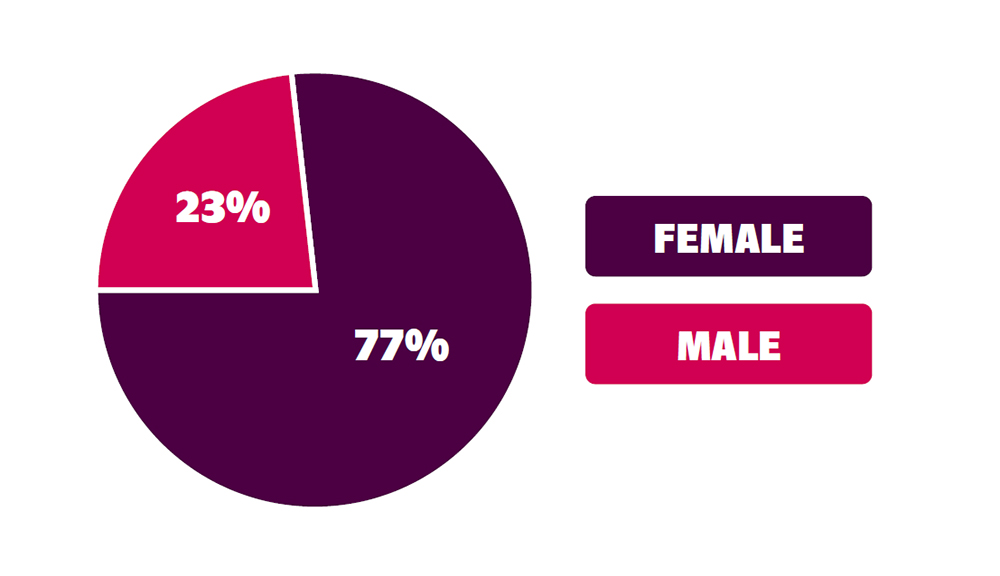
In April 2025 Royal Voluntary Service employed 613 reportable colleagues, broken down as follows:
- 469 (77%) - Female colleagues (496 & 78% in April 2024)
- 144 (23%) - Male colleagues (144 & 22% in April 2024)
Median gender pay gap
The median gender pay gap has increased from 1.93% in April 2024 to 3.41% in April 2025
The median gender pay gap is the difference in pay between the middle-ranking female employee and the middle-ranking male employee. The median gender pay gap has increased from 1.93% in 2024 to 3.41% in 2025. The median gap is less impacted by outlier numbers than the mean as it compares the ‘middle’ pay point for a woman and a man, if all pay for both were ranked from low to high.
The median pay gap is generally regarded as more representative than the mean pay gap. The Royal Voluntary Service median pay gap compares favourably with the national median gender pay gap among all UK employees, which was 13.1% in 2024 (Office of National Statistics). When comparing median hourly wages, Royal Voluntary Service employees who are women earn 97p for every £1 that Royal Voluntary Service employees who are men earn.
Mean gender pay gap
The mean gender pay gap has decreased from 17.74% in April 2024 to 17.73% in April 2025
The mean GPG is the difference between the average amount earned by female employees and the average amount earned by male employees per hour. The mean GPG has decreased from 17.74% in 2024 to 17.73% in 2025. This suggests that, on average, the Charity pays women 17.73% less than men, even though the Charity employs significantly more women. The gap is largely attributable to a greater proportion of women in lower paid roles, compared with the proportion of men in higher paid roles, particularly at the upper quartile. There are also more women working in part-time roles.
Gender pay gap movement since the 2025 gender pay gap report
The median gap is below the national average, and the mean average while high can be negatively influenced by outliers more easily
The negative reduction in both the median gender pay gaps since April 2024 is believed to be largely attributable to the large proportion of females who are represented in the lower roles, the median can be skewed meaning the data can deviate, however the median is more reliable than the mean average as the median takes the middle value when the data is ordered, making it more robust from outliers. The Royal Voluntary Service mean average is above the average, largely because of women in the lower paid roles. Royal Voluntary Service is mitigating any future disparity, by the following:
- Pushing the pay of the Charity’s lowest paid colleagues above the National Minimum Wage and taking further steps towards paying the Real Living Wage and phasing full achievement of this over the first few years of implementing the review.
- Introducing a job evaluation scheme that determines the pay of colleagues in a fair and objective manner.
Pay quartiles
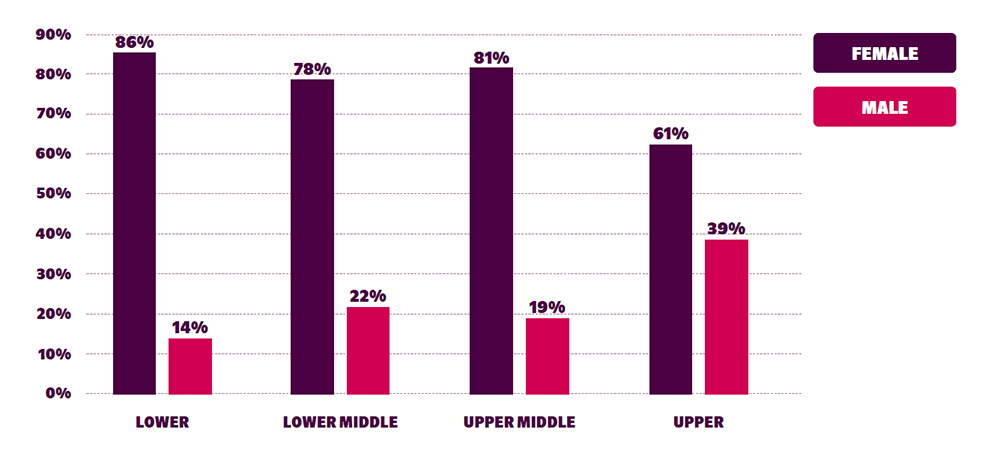
The gender pay gap at Royal Voluntary Service is influenced by a couple of key issues. As with many charities, Royal Voluntary Service’s staff are predominantly women. We have more than three times as many female employees as men. Analysis reveals that when employees are divided into four groups based on pay (‘pay quartiles’), female employees outnumber male in all four quartiles. However, the pay quartile with the highest proportion of men is the upper quartile (39% men and 61% women). Further, the mean average pay for women and men is nearly identical for the lower quartiles.
Quartile distribution
Lower paid roles
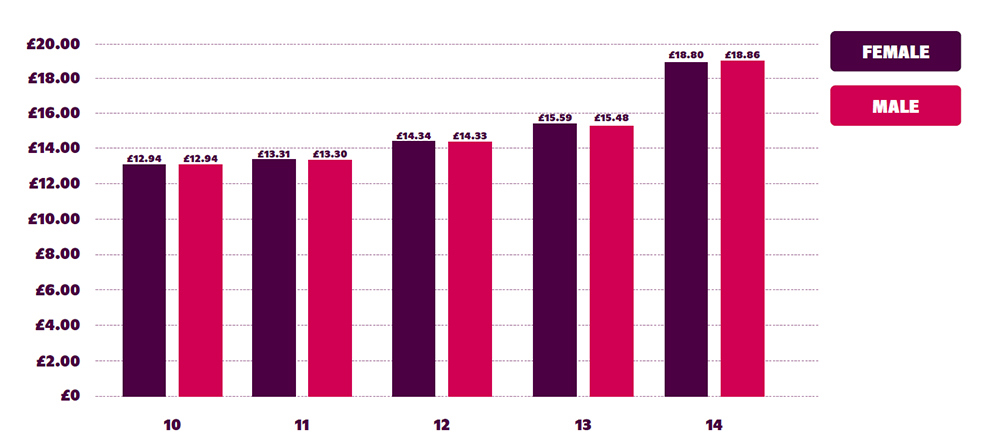
In the following graph, we can see the lowest grade employees (278 employees), are roughly paid equal, as there are a higher proportion of women in these roles we can see how this has skewed the figures.
Function distribution
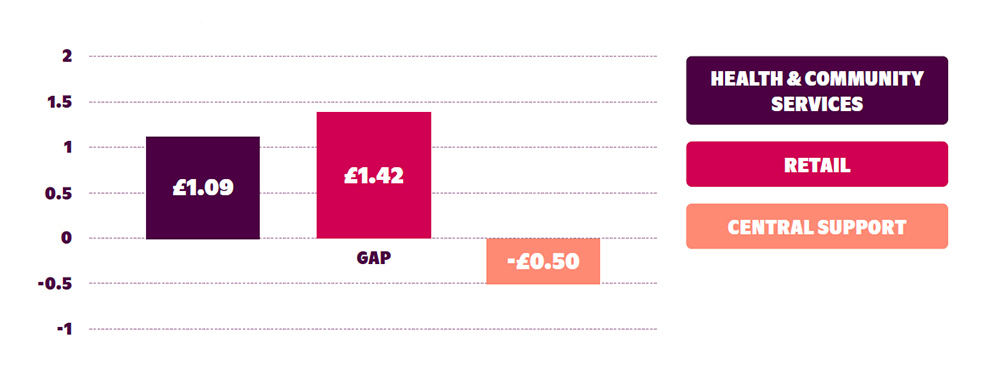
It is important to demonstrate that the gap is more prevelant in our Retail division, where our lower paid roles predominantly sit and men are paid £1.42 per hour more per hour. Central support roles, which have the greater proportion of full time roles (86%) than retail roles (23%), women are paid more by 50p per hour. Furthermore, women predominantly work retail (83%), while in central support support men have a significantly lower proportion of women (57%), albeit still higher than men.
By division gap
The table below shows how the proportion of male and female colleagues across the four pay quartiles has shifted over the last three years. As shown, there is little change in the composition of men to women; but the proportion of women in the lowest quartile has increased from 78% in 2023 to 86% in 2025.
| Quartile |
Female (2025) |
Male |
Female (2024) |
Male (2024) |
Female (2023) |
Male (2023) |
| Upper | 61% | 39% | 62% | 38% | 64% | 36% |
| Upper middle | 81% | 19% | 80% | 20% | 81% | 19% |
| Lower middle | 78% | 22% | 83% | 17% | 81% | 19% |
| Lower | 86% | 14% | 85% | 15% | 78% | 22% |
The changes in the proportion of male and female colleagues across the four pay quartiles over the last three years has impacted the gender pay gap over the period.
Dianne Hughes
Chair, People & Remuneration Committee
Trustee
I confirm that our data has been calculated according to the requirements of the Equality Act 2010 (Gender Pay Gap Information) Regulations 2017.
WRVS (Services Welfare)
On the reporting date of 5 April 2025, WRVS had 60 employees: 45 females and 15 males. The gender composition was thus 75/25 in favour of women.
- 8% less than males - Median gender pay gap in hourly pay
This represents the difference between the median hourly rates of pay of male and female relevant employees.
- -8 % less than males - Mean gender pay gap in hourly pay
This represents the difference between the mean hourly rates of pay of male and female relevant employees.
This highlights that for the entity of WRVS, women are paid more as a mean average (8%), while the median average is 8%, crucially it can be seen that both the mean and median can be influenced significantly by outliers due to the lower numbers than Royal Voluntary Service.
Action Plan
As part of our commitment to pay equity, Royal Voluntary Service publishes gender pay gap (GPG) data to provide transparency about pay differences between male and female colleagues. This reporting helps us assess how pay is distributed across the organisation and identify where action is needed.
Our analysis shows that the main drivers of the gap are structural, including workforce composition and the distribution of roles. This action plan sets out the steps we will take, many of which are already underway, to address those underlying factors and support sustained progress over time.
Recruitment & retention
We will strengthen transparency and consistency in how we attract, recruit and retain colleagues.
- We will ensure our pay, benefits and reward offer is clearly communicated from the earliest stage of recruitment.
- We will review our website and recruitment policy to ensure our recruitment and selection processes are fair, consistent and transparent.
- We are implementing a new recruitment platform, which will enable more dynamic and user-friendly content. As part of this, we will review the language, imagery and branding used to promote careers at Royal Voluntary Service.
- We will review recruitment and selection training to ensure it supports an inclusive and gender-neutral approach throughout the process.
- We will update the recruitment and selection management guide to ensure interview questions and assessment approaches are free from gender bias.
- For senior recruitment and promotions, we will continue to use mixed panels (including a balance of gender and seniority) to support fair decision-making.
- We will carry out annual audits of promotions to identify whether women are less successful at any stage and take action where needed.
- We will review flexible working arrangements, including working patterns and hours, to better support colleagues with caring responsibilities and commitments outside work.
- Where executive search firms are engaged, we will require diverse longlists, including an appropriate representation of female candidates.
- We will review our exit interview process to improve how reasons for leaving are captured and analysed alongside diversity data, including gender.
Workforce Data & HRIS
We are strengthening our data capability to improve insight, transparency and future reporting.
- The implementation and continued development of the HiBob HRIS platform will improve our ability to analyse workforce data across key characteristics, including gender, disability and ethnicity.
- As data quality and completion rates improve, we will make fuller use of HiBob reporting and dashboards to better understand workforce composition and employee experience.
- This will support more robust analysis of trends and help us identify and address barriers affecting progression and retention.
It will also strengthen our readiness for broader pay gap reporting in future, including voluntary reporting on other pay gaps where data is sufficiently robust.
Real Living Wage
The approach taken through the pay and grading review has prioritised improvements for our lowest-paid roles, which are predominantly occupied by women.
- As part of this review, we committed to paying the Real Living Wage and are developing an implementation plan.
- Progressing this commitment is expected to have a positive impact on our gender pay gap over time.
Progression
We will support fair access to development and progression opportunities across the organisation.
- Through the annual PDR process and learning needs analysis, we will support more women to access development opportunities, including the Management Pathway Programme, to build the skills and experience needed to progress.
- We will improve transparency around career pathways and the knowledge, skills and experience required for roles.
- We recognise that a high proportion of women at Royal Voluntary Service work part time. We will ensure part-time colleagues are well supported, receive effective line management, and have equal access to development and progression opportunities.
Policies & procedures
We will review and strengthen people policies and practices that affect retention, progression and return-to-work experience.
- We will review our family leave and shared parental leave policies, practices and take-up levels, including ways to improve take-up where it is low (for example, among male colleagues).
- We will continue to support colleagues during maternity leave and support line managers to use keeping-in-touch days effectively to help create a positive return-to-work experience.
- We will develop individual plans for colleagues on maternity leave, including how they wish to stay informed about relevant updates, organisational changes and vacancies, and discussions about return-to-work arrangements.
- We will introduce guidance for managers on supporting colleagues during maternity, adoption and shared parental leave.
Data analysis & reporting
We will continue to improve the quality of our reporting and the clarity of our narrative.
- We will publish gender pay gap data on our website, alongside a narrative explaining the key drivers of the gap and the actions we are taking.
- As part of our wider inclusion work, we will strengthen trend analysis over time, including by job role and service area where data allows.
- The implementation of our new recruitment platform will improve our ability to analyse diversity data across the employee lifecycle, from attraction through to exit.
- This will support more detailed analysis of potential barriers affecting people with protected characteristics and help us target improvement activity more effectively.